
Article content
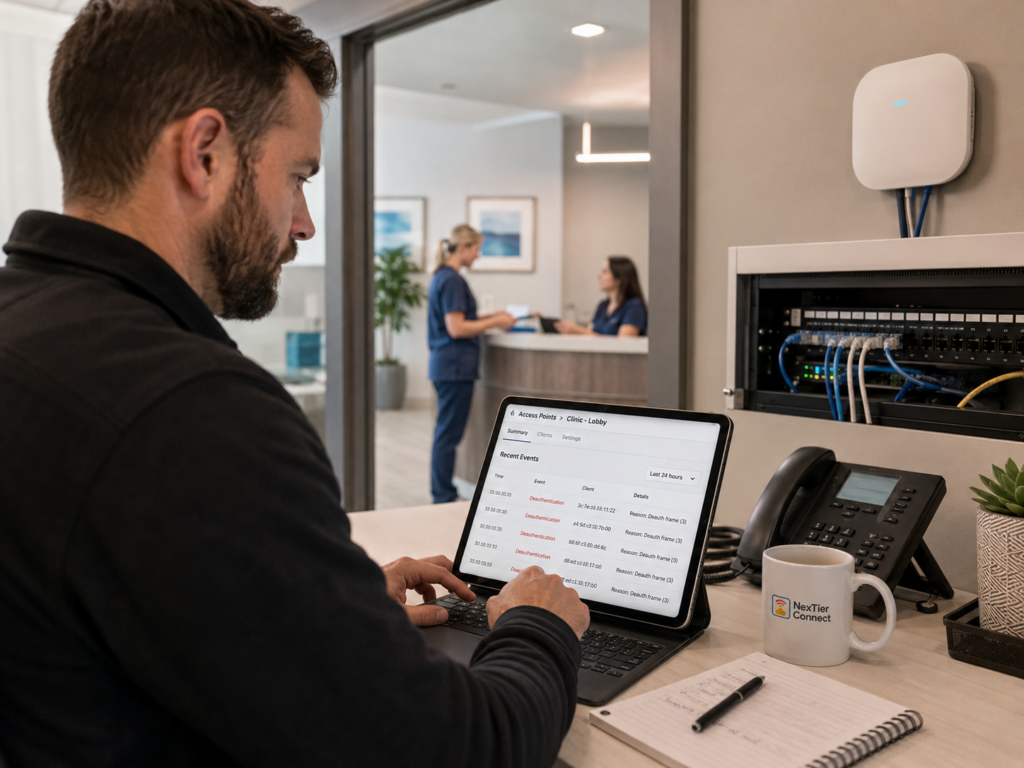
When we think about Wi-Fi, we usually think about speed, coverage, or the internet provider. But for small companies, Wi-Fi is part of the business operation.
If the Wi-Fi fails, payments, VoIP calls, cloud apps, guest access, tablets, printers, and daily work can be affected. For a dental clinic, hotel, school, or small office, this can quickly become a real problem.
One attack that is easy to underestimate is a deauthentication attack. In simple words, it can force devices to disconnect from the Wi-Fi network. From the user side, it may only look like bad Wi-Fi, random drops, or unstable connections.
What we noticed
The biggest challenge is that small companies often do not see this as a security issue. They may restart the router, call the internet provider, or replace equipment, but the real problem could be related to weak wireless protection, poor segmentation, or lack of monitoring.
This is why we should not treat Wi-Fi as “just connectivity.” We need to look at it as part of the security and reliability of the business.
What we can do
A practical solution does not need to be complicated or tied to one vendor.
We can start with a few basic steps:
- Review the current Wi-Fi design.
- Separate business, guest, and IoT devices.
- Enable Protected Management Frames when devices support it.
- Move gradually to stronger security like WPA3.
- Monitor disconnections, authentication failures, and unusual Wi-Fi behavior.
- Validate coverage and performance with real testing, not only assumptions.
For some environments, Protected Management Frames can help reduce the risk of forged deauthentication traffic. However, we need to test compatibility first, especially when old printers, cameras, tablets, or IoT devices are involved.
What we learned
Good Wi-Fi is not only about strong signal. It is about stability, visibility, and protection.
Small companies do not need enterprise complexity, but they do need a basic wireless security strategy. A strong password is not enough if all devices are mixed together, nobody is monitoring the network, and old configurations are still in use.
The key learning is simple: when Wi-Fi becomes critical for the business, we need to protect it like any other important service.
Final thought
Deauthentication attacks are a good reminder that “bad Wi-Fi” is not always just bad coverage. Sometimes it can be a sign of a deeper design or security problem.
Our goal should be simple: build Wi-Fi networks that are stable, secure, easy to support, and ready for the real needs of small businesses.
Operational Support
Need Help Applying This in Your Environment?
Our team can help plan practical improvements for reliability, visibility, and connectivity operations.